
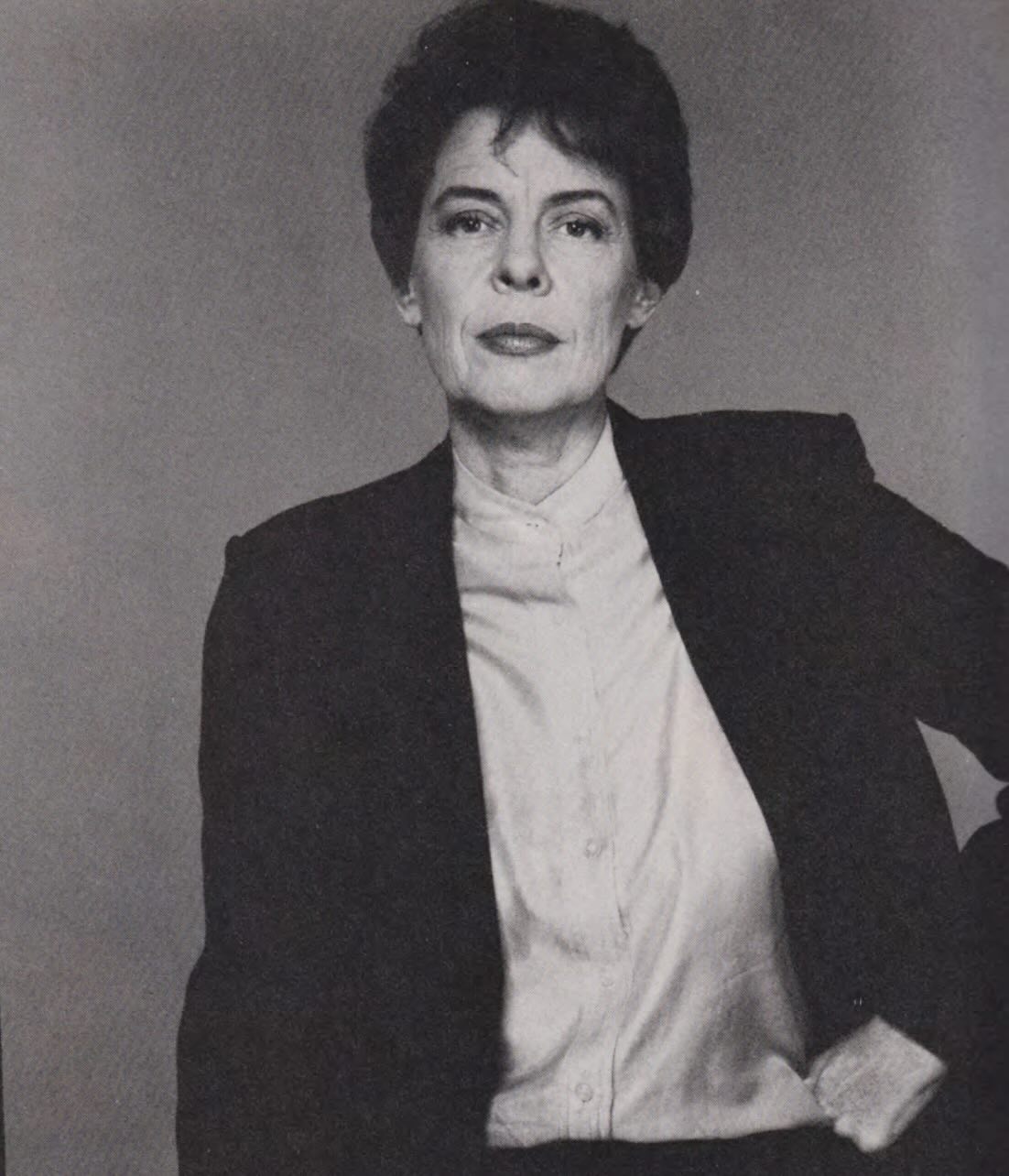
Original Publication – Vogue July 1, 1981
People Are Talking About . . .
Jeane Kirkpatrick – A “Woman Capable of Reason”
Jeane Kirpatrick is the most powerful woman in our government today. As United States Ambassador to the United Nations and a member of Reagan’s cabinet, she is not only the messenger of our foreign policy, she also helps to formulate the message. In two of the most explosive areas of the world, Latin America and Africa, she is one of the very few people who are calling the shots.
She is a smallish woman who is softer looking than she photographs and walks briskly, her head tilted up as though it were some sort of sensitive scanner programmed to receive thousands of signals per micro-second, and probably it does. In New York, one early evening recently, at the end of a day that had begun at 5:00 a.m. in the Washington, DC, suburb where she lives, she was crossing from the soaring glass tower of the United Nations Secretariat to her office at the U.S. Mission. Nothing in her manner betrayed the power of her office; something else did. She was surrounded by three deferential male aids who carried her papers and scurried to keep up.
Jeane Kirkpatrick is usually surrounded by men these days, fast moving, high-ranking diplomats and government officials whom she addresses easily in English, French, or Spanish. It is the first time within the memory of anyone around the U.N. that a U.S. ambassador could speak any language other than English. But then there are many “firsts and onlys” surrounding the fifty-four-year-old Jeane Jordan Kirkpatrick, the daughter of a Texas oil wildcatter, born in the small frontier town of Duncan, Oklahoma.
A trained academic with a Ph.D. in political science but untrained in diplomacy, Kirkpatrick is the U.S.’s first woman permanent representative, and the only woman ambassador, at the 154-member U.N. She is also the one woman of cabinet rank in the Reagan administration, a great favorite of the President, and a registered Democrat to boot. An advocate of women’s rights, she is also happily married, the mother of three trilingual sons a Francophile, a sophisticated cook, an excellent hostess, and a prolific writer. If brains are sexy, the Jeane Kirkpatrick is the Sophia Loren of diplomacy.
Certainly, Ronald Reagan has made no secret of the fact that he thinks Jeane Kirpatrick is just swell. He made that clear around the fifteenth of last December when he tracked her down in Florida where she was giving a speech. “If you really want to make my day, Jeane,” the President told her, “you’ll agree to be the United Nations ambassador.”
Yet, Jeane Kirkpatrick is not the total superwoman who sends other women into fits of depression. Her life is a series of unplanned twists of fate and well-earned “surprises.” “I’ve never had a career goal in my life,” Kirkpatrick says. “I’ve never felt a drive to pursue a specific career – I guess you could say I’m an experience collector. My goals is living to the hilt.”
Living to the hilt, however, is not defined by Kirkpatrick as the mindless pursuit of pleasure. A kind of informed passion permeates her, a zest for life and learning that, combined with a prodigious capacity for hard work, produces certain results. “In the academic environment of university teaching, Jeane has been remarkably free to pursue her interests,” says her husband, Evron Kirkpatrick, Ph.D., executive director of the American Political Science Association. “By reading books, talking to people, traveling, formulating her thoughts through writing and teaching, she has turned her interests into a body of expertise that is hard to come by in this world.”
Kirkpatrick has come a long way by pursuing her passions. No woman in recent U.S. history has held such a high position in the field of foreign policy. Women, if they are considered at all, usually have to settle for cabinet posts in the Departments of Commerce or Health and Human Services. Not Jeane Kirkpatrick. “She is a member of the National Security Council, as well as a trusted advisory of the President and the Secretary of State,” says Elliot Abrams, Assistant Secretary of State for international organizations. “She is key policymaker on foreign policy in this administration.” And how is Kirkpatrick getting along with the proud and prickly Secretary of State Alexander Haig? “Great,” says Abrams, “so far. They’re very different, but instead of clashing they’re complementary.”
Perhaps because she is forthright in her views and not afraid to express them, Kirkpatrick has acquired a reputation for being tough. Even her husband uses the word to describe her, though, only, he says, “in the very best sense of the word. I have lived with her for twenty-six years. She is my best critic; and I can tell you, she is a tough, strong woman.”
“There’s a lot of fraud in that reputation,” Kirkpatrick insists. “I think for a lot of people, commitment to intellectual clarity is associated with toughness. I am not someone who is personally tough. I’m not.”
Personally, Kirkpatrick is a fascinating conversationalist, friendly and very candid with people. Even so, a lot of her opinions are considered very tough-minded indeed, and open to dispute. In fact, The New Republic magazine, which endorsed her, called Kirkpatrick “Reagan’s most controversial foreign policy appointment.”
In March, the Congressional Black Caucus asked for her resignation when it was learned that, in violation of U.S. policy, she had met with two high-ranking South African military intelligence officers. Kirkpatrick at first claimed she did not know who they were (her predecessor Andrew Young was forced to resign when he broke policy by meeting with a member of the P.L.O.).
Critics, especially those who have read her two widely discussed articles on foreign policy in Commentary fear that Kirkpatrick is a rigid hardliner, willing to ignore human rights in the name of anticommunism and to use U.S. power to prop up oppressive right-wing regimes. They accuse her, as The Christian Century did recently, of “a failure to identify human goals as a context for realistic policymaking.
“My God, I think it matters greatly how a regime treats its own people. That’s the basis for my anticommunism,” Kirkpatrick replies. “My criticism of Carter’s foreign policy is that it didn’t work. It was designed to secure moderate democratic governments, but what it produced was the Ayatollah Khomeini and communists on the Nicaraguan junta. I’d like to have policies oriented towards the same goals that do work.”
It’s an amusing irony that Jeane Kirkpatrick, now in the eye of the storm of world politics, had never heard a foreign language until she was sixteen, four years after her family moved from Oklahoma to southern Illinois.
“I really think the biggest thing in my formative life was that move,” Kirkpatrick says. In the seventh grade in Oklahoma, she had studied the Civil War from the perspective of the South. In Illinois, in the eighth grade, she had to relearn it from the point of view of the North. “Suddenly all of the bad guys were good guys,” she says. “It was an important lesson about the influence of perspective on the perception of events.”
During her childhood and adolescence, Kirkpatrick says, she was “the ideal sort of girl” who got straight A’s, had a flair for theater, played the piano, and edited the school paper. But she was also a closet intellectual. When she started at nearby Stephens College, in Columbia, Missouri, Kirkpatrick at last was praised for what she’d been hiding – her brains. After two years, she transferred to Barnard College in New York and decided to major in political science. During that time, Kirkpatrick’s announced ambition was to be a spinster teacher. She was also an incipient feminist who carried around a well-thumbed copy of Virginia Woolf’s A Room of One’s Own. “My attitude today, which is basically what it was at eighteen,” says Kirkpatrick, “is that women really ought to be able to be free to do anything they want to do.”
After acquiring an M.A. in political science at Columbia in 1950, Kirkpatrick took a job at the State Department, and her boss turned out to be the man she would marry. The romance didn’t begin to blossom, however, until the next year when, bored with the State Department bureaucracy, Jeane Jordan went to France to take a fellowship and to begin her lifelong love affair with that country. Evron “Kirk” Kirkpatrick, fifteen years her senior, found himself traveling frequently to Paris and engaging his “young colleague,” as he thought of her, in lively political discussion. “She was a talking partner in the beginning,” Evron Kirkpatrick says, “a very smart gal, and I found that very attractive.” They didn’t marry, however, until 1955, when Jeane Jordan was working on a defense department contract job which fascinated her.
She was involved in analyzing data on the Chinese refugees captured in the Korea War who refused to be repatriated – essentially because the new Chinese Communist regime was relentlessly trying to “deprogram” the old society and impose the new by brainwashing.
Her anticommunism dates from that period. In college and graduate school, Kirkpatrick had been deeply shocked by the Holocaust data which had just become available; by what she saw as politics’ “potential for evil.” Now, studying the Chinese interviews, she found a similar potential in communism.
“I think the distinctive mark of communism in our time is that it sets a claim to the conscious and subconscious, a basic claim to the subjectivity of individuals. This is what accounts for refugee movements – the boat people, the Cubans risking sharks and drowning rather than going on living where they are.”
Kirkpatrick’s husband, who was a great pal of Hubert Humphrey’s, led her from a purely academic vantage into party politics. He has always been her mentor and she says, “my most trusted advisor.”
“Her key advisor, really,” Elliot Abrams says. “When I ask her about something and we discuss it, she’ll say, ‘Let’s talk again tomorrow.’ The next morning she’ll say, ‘I’ve talked about it with Kirk and he thinks. . .’”
The Kirkpatricks even spent their honeymoon at a political science convention. But when Jeane Kirpatrick became a mother, politics paled considerably. Within twenty four hours of her son’s birth, Kirkpatrick decided to give up work and stay home, and she did – for nearly nine years. “I was hit very hard by the stirrings of motherhood,” she says. “I had mixed feelings about getting married, getting pregnant; and then suddenly here was this incredible creature, and it was like being infatuated but it doesn’t end.”
Later, the family would vacation and take two sabbatical years in the South of France where the boys went to school. Today, Douglas, twenty-four, and John, twenty-two, are in law school, and Stuart, twenty-one, is in college. But during the period that Kirkpatrick calls her “intensive child-bearing years” – at one point she had three boys under the age of four at home – she continued to read widely in both literature and politics.
When Stuart went off to first grade, Kirkpatrick began to teach part-time at Trinity College. Then she plunged into study, and in 1968 at the age of forty-one, and after only two-and-a-half years, she earned her Ph.D. with a study on Peronist Argentina.
Since then, in a fury of work, Jeane Kirkpatrick has become a recognized expert on Latin America, written four books and numerous scholarly articles. She has become a fellow at the conservative American Enterprise Institute and a popular professor on the Georgetown University campus, where she teaches, among other things, a course on the influence of personality on politics – an outgrowth of her belief in personal diplomacy. “I believe in personal everything,” Kirkpatrick says. “My view is that politics is people acting in political roles. I have no use, either intellectually or personally, for dehumanized conceptions.”
In 1972, and again in 1976, Kirkpatrick, ever active in Democratic party politics, was disappointed by what she considered to be the drift of the party away from “its goal – the views and values of ordinary Americans.” With her husband and others, she helped to found the Coalition for a Democratic Majority, a group of Democrats who espouse traditional liberal views on social issues but are hardliners on foreign policy. In time, she and her husband were dubbed as “neocons,” that now select network of conservative Democrats who came together out of a concern for what they perceived to be the decline of American power in the world and who publish many of their opinions in Norman Podhoretz’s magazine Commentary. After reading Kirkpatrick’s “Dictatorships and Double Standards” in Commentary, Ronald Reagan, a few months away from declaring for the Presidency, sent Kirkpatrick a long fan letter and asked if they could meet.
Kirkpatrick could not have been more surprised. She was not even planning to publish the article until her husband convinced her it was important. “I hate having unacceptable and unfashionable views of the world,” Kirkpatrick says, “I thought the sky was going to fall on me.” The controversial article argued that Jimmy Carter’s “self-abasing” policies “had hastened the victory of even more repressive dictatorships” in Nicaragua and Iran; and it criticized our abandonment of “friendly autocracies” for alignment with the forces of change, no matter what their ties to the Soviets might be.
Reagan’s timing was impeccable. Shortly after receiving his letter. Kirkpatrick and other Democratic critics of Carter’s foreign policy had a traumatic meeting with Jimmy Carter, after which she felt absolved of supporting Carter for reelection. “He didn’t listen,” Kirkpatrick says. “When I met Reagan, on the other hand, he listened very carefully, asked questions, and was very open.”
Kirkpatrick’s first order of business at the U.N. is overseeing a complete reorientation of American foreign policy. “I think for a long time we have not behaved as though foreign policy ought to pursue the national interest. We should once again accept the legitimate, acceptable, appropriate goal of U.S. foreign policy ought to pursue the national interest. We should once again accept the legitimate, acceptable, appropriate goal of U.S. foreign policy to be the defense of a civilized conception of the American national interest.”
That is a tall order, considering much of the Third World-dominated U.N. today is essentially hostile to her views. Characteristically, Kirkpatrick remains undaunted. Right now, there is a bureaucracy to organize – she’s never managed a bureaucracy before. And, also, as she demonstrated with the ill-fated meeting with the South African military officers, the whole world of diplomacy is completely new to her. Kirkpatrick’s two Commentary articles have been widely read at the U.N., however; and, in the words of one ambassador, “She at least gets high marks for being a woman capable of reasoning.”
“She complains about her schedule,” says her husband. “But I told her, ‘Nonsense. You’ve never looked better. You’re thriving.’” And so she is. But this day has been a long one, and close to 8:30 p.m. on a Friday night, Madame Ambassador scoops up some Reagan jelly beans she keeps in her office and, accompanied by two male aides, races to catch the last air shuttle back to Washington. Stepping off the elevator at the U.S. Mission, Jeane Kirkpatrick clutches the French magazine Madame Figaro, which has an article about her that says, “Cette femme est ‘l’homme de fer’ de Ronald Reagan” – “This woman is Ronald Reagan’s iron man.”
This article is typed from the original material. Please excuse any errors that have escaped final proofreading.


No Comments